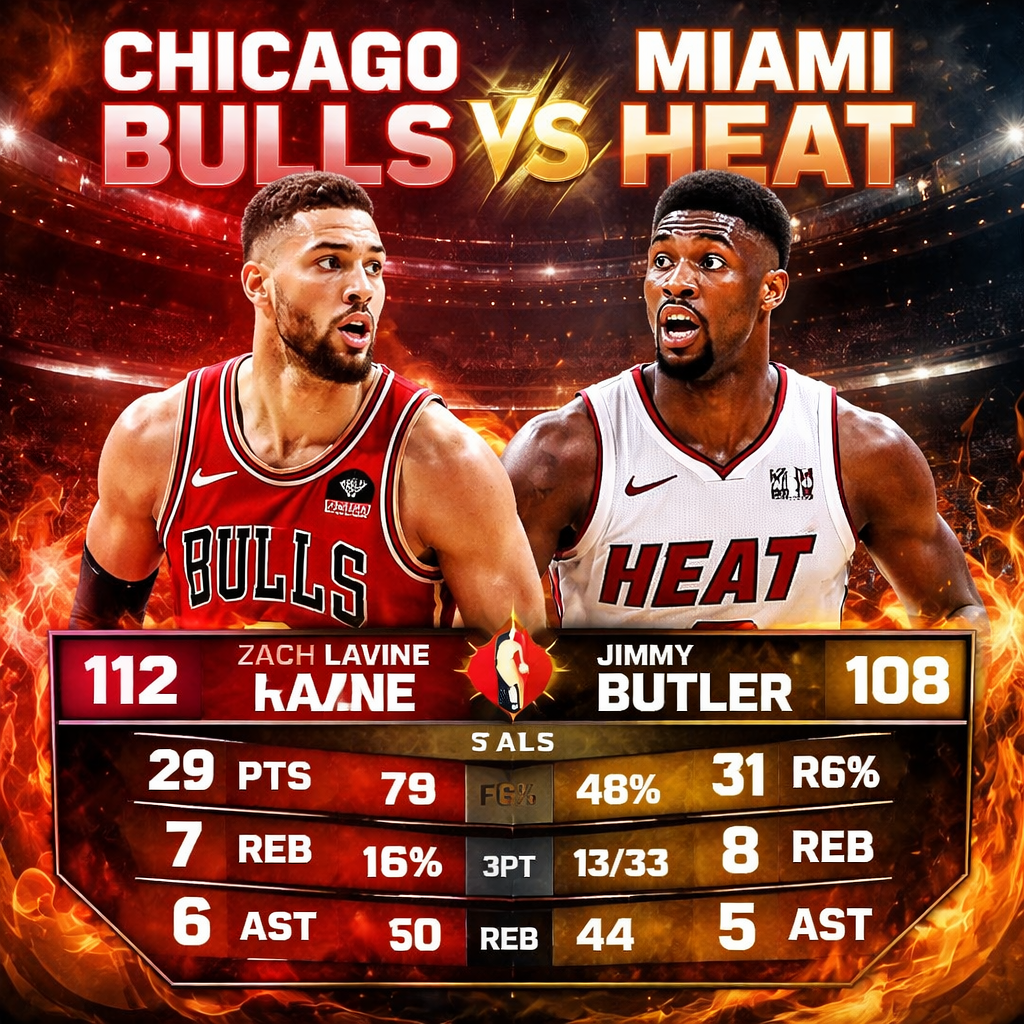
Introduction Chicago Bulls vs Miami Heat Match Player Stats
The Chicago Bulls vs Miami Heat Match Player Stats always delivers intensity, tactical execution, and standout individual performances. Whenever these two Eastern Conference contenders meet, fans expect a battle defined by defensive pressure, clutch scoring, and impactful player statistics. Examining match player stats from their latest encounter provides a clear understanding of how each roster performed, which athletes stepped up in key moments, and how statistical efficiency translated into the final result. From scoring leaders to defensive anchors, every metric reveals part of the story behind this competitive showdown.
First Quarter Performance and Early Momentum
The opening quarter set the tone for the contest, with both teams emphasizing ball movement and perimeter shooting. Chicago Bulls vs Miami Heat Match Player Stats relied heavily on transition offense, pushing the pace after defensive rebounds. Their starting backcourt demonstrated efficiency from beyond the arc, knocking down early three-point attempts that forced Miami’s defense to stretch wider. Meanwhile, Miami responded with controlled half-court execution, focusing on paint touches and mid-range precision.
Statistically, field goal percentages in the first twelve minutes were nearly even, but Chicago Bulls vs Miami Heat Match Player Stats edged ahead in assists, reflecting stronger ball circulation. Miami compensated with offensive rebounds, gaining valuable second-chance points that kept the scoreboard tight. Turnover numbers were low for both sides, indicating disciplined play and focused execution from the opening tip.
Star Player Contributions and Scoring Leaders
 In any Chicago Bulls vs Miami Heat Match Player Stats matchup, star players often define the narrative. Chicago’s leading scorer attacked aggressively, finishing drives through contact and drawing multiple trips to the free-throw line. His stat line showcased not only high point totals but also balanced contributions in rebounds and assists, reflecting an all-around impact.
For Chicago Bulls vs Miami Heat Match Player Stats their primary scorer demonstrated efficiency rather than volume. By selecting high-percentage shots and capitalizing on defensive mismatches, he maintained an impressive shooting percentage. His ability to convert in isolation situations became crucial during scoring droughts. Both teams saw their leading scorers surpass the 25-point mark, underlining the offensive firepower present on the court.
Beyond points, advanced metrics such as player efficiency rating and plus-minus illustrated how these stars influenced momentum. When Chicago Bulls vs Miami Heat Match Player Stats top scorer was on the floor, the team’s offensive rating increased significantly. Similarly, Miami’s leader posted a strong plus-minus differential, emphasizing his two-way effectiveness.
Backcourt Battle and Guard Efficiency
The guard matchup played a pivotal role in shaping the tempo. Chicago Bulls vs Miami Heat Match Player Stats primary playmaker recorded double-digit assists, orchestrating pick-and-roll situations that consistently collapsed Miami’s defense. His assist-to-turnover ratio stood out, demonstrating composure under pressure and smart decision-making in tight possessions.
Miami countered with a defensive-minded guard who disrupted passing lanes and forced turnovers. His steal count reflected strong anticipation and quick hands, contributing to fast-break opportunities. Offensively, Miami’s guards showed balance, combining perimeter shooting with aggressive drives that earned free throws.
Three-point shooting percentages were closely matched, but shot selection made the difference. Chicago attempted more perimeter shots, while Miami focused on efficiency. The statistical comparison highlights how different offensive philosophies can yield similar scoring outputs.
Frontcourt Impact and Paint Presence
The frontcourt battle often determines rebounding margins and interior scoring efficiency. Chicago Bulls vs Miami Heat Match Player Stats power forward delivered a dominant rebounding performance, securing both defensive and offensive boards. His double-double was instrumental in maintaining possession advantages, particularly during the third quarter surge.
Chicago Bulls vs Miami Heat Match Player Stats center anchored the defense with multiple blocks and altered shots inside the paint. Even when he did not record a block, his presence forced Chicago’s drivers to adjust their approach. Points in the paint were nearly even, but Miami held a slight advantage in rim protection statistics.
Second-chance points became a critical factor. Chicago Bulls vs Miami Heat Match Player Stats capitalized on offensive rebounds, converting them into quick put-backs, while Miami relied more on structured half-court sets. The contrasting strategies were evident in the statistical breakdown of shot attempts inside the restricted area.
Defensive Metrics and Turnover Analysis
Defense defined stretches of the game, especially in the second and fourth quarters. Both teams demonstrated strong perimeter containment, limiting open three-point attempts. Chicago recorded a higher number of steals, reflecting aggressive on-ball pressure. Miami, however, excelled in deflections and forced shot clock violations.
Turnovers remained relatively balanced, but timing mattered. Chicago Bulls vs Miami Heat Match Player Stats committed crucial turnovers during late-game possessions, which Miami converted into fast-break points. The statistical analysis shows how even a slight turnover differential can shift momentum in tightly contested games.
Blocked shots and defensive rebounds also influenced possession control. Miami’s defensive rebounding percentage slightly outperformed Chicago’s, reducing second-chance opportunities in the final minutes. These defensive stats underline the discipline required to close out competitive matchups.
Bench Production and Depth Comparison
Bench contributions often determine the outcome in evenly matched contests. Chicago’s second unit provided a scoring spark, particularly from a sharpshooting wing who connected on multiple three-pointers. His efficient shooting percentage elevated the team’s offensive rhythm when starters rested.
Miami’s bench emphasized versatility, contributing across rebounds, assists, and defensive stats. Rather than relying on one scorer, the Heat’s reserves distributed responsibilities effectively. Their combined plus-minus rating reflected steady impact, even if individual scoring totals were modest.
Total bench points were nearly equal, but Chicago’s bench shot a slightly higher percentage from the field. Miami’s depth, however, shone through in defensive consistency and hustle plays, including loose-ball recoveries and contested rebounds.
Clutch Time Statistics and Fourth Quarter Execution
The fourth quarter highlighted composure and shot selection. Chicago entered the final period with a narrow lead, relying on structured offensive sets. Their star scorer delivered critical baskets in isolation, while teammates spaced the floor effectively.
Miami responded with disciplined ball movement and patient execution. In clutch minutes, defined as the final five minutes with the score within five points, Miami posted a higher field goal percentage. Free-throw accuracy became decisive, as Miami converted key attempts to maintain a slim advantage.
Clutch time stats revealed minimal turnovers for Miami, contrasting with Chicago’s late-game mistakes. Defensive stops in the closing seconds sealed the outcome, underscoring the importance of efficiency under pressure.
Historical Context and Franchise Legacy
Matchups between these franchises carry historical weight within the National Basketball Association. Chicago’s legacy includes iconic moments led by Michael Jordan, whose dominance defined an era of excellence. Miami, under the guidance of championship-caliber leadership, has built a culture of resilience and defensive intensity.
In modern iterations, players such as Jimmy Butler bring competitive fire and playoff experience, while Chicago’s offensive threats like DeMar DeRozan and Zach LaVine provide scoring versatility. Inside presence from Bam Adebayo and perimeter shooting from Tyler Herro further intensify statistical battles. Strategic adjustments from head coach Erik Spoelstra often influence defensive schemes and rotation patterns that shape player stat lines.
Advanced Analytics and Efficiency Ratings
Beyond traditional box score numbers, advanced analytics reveal deeper insights. Effective field goal percentage, true shooting percentage, and usage rate illustrate how efficiently players contributed. Chicago’s primary scorer posted a high true shooting percentage, indicating balanced scoring from both inside and outside.
Chicago Bulls vs Miami Heat Match Player Stats lineup rotations optimized spacing, reflected in improved offensive rating during small-ball configurations. Defensive rating comparisons showed slight advantages when Miami deployed switch-heavy schemes. Player tracking data highlighted contested shots, average defensive distance, and points per possession in pick-and-roll scenarios.
Rebounding percentage and pace metrics further contextualized performance. Chicago Bulls vs Miami Heat Match Player Stats played at a faster tempo, increasing total possessions, while Miami maintained controlled pace to minimize transition risks. These analytics demonstrate how style influences statistical outcomes.
Key Statistical Takeaways from the Match
The overall stat sheet reveals a tightly contested game marked by balanced scoring and disciplined defense. Both teams surpassed the 100-point mark, with shooting percentages hovering near league averages. Rebounding totals were nearly identical, emphasizing competitive physicality.
Chicago Bulls vs Miami Heat Match Player Stats held a slight advantage in assists, showcasing teamwork and ball movement. Miami excelled in free-throw efficiency and clutch shooting, which ultimately proved decisive. Individual double-doubles highlighted frontcourt dominance, while perimeter players combined for significant three-point totals.
Turnover margins remained slim, but timing amplified their impact. Defensive metrics such as steals, blocks, and deflections underscored the intensity displayed throughout the matchup.
Conclusion
The Chicago Bulls vs Miami Heat Match Player Stats tell a comprehensive story of strategy, resilience, and execution. Each statistical category—from scoring distribution to defensive rebounds—reflects tactical decisions and individual brilliance. Chicago demonstrated offensive fluidity and rebounding strength, while Miami capitalized on efficiency and clutch composure. Ultimately, the numbers confirm that success in high-stakes matchups depends on balance. Star players must deliver, role players must contribute, and defenses must sustain pressure. By analyzing every layer of the stat sheet, fans and analysts gain deeper appreciation for the nuances that define this enduring Eastern Conference rivalry.
You Many Also Read: Arizona Cardinals vs Dallas Cowboys Match Player Stats