Introduction San Antonio Spurs vs Dallas Mavericks Match Player Stats
The rivalry between the San Antonio Spurs vs Dallas Mavericks Match Player Stats has long been one of the most compelling matchups in the Western Conference. Whenever these two Texas franchises meet, fans expect intensity, skill, and standout individual performances. A detailed look at the match player stats from their recent encounter highlights how individual contributions shaped the tempo, momentum, and final outcome of the game. From scoring efficiency to defensive presence, every statistical category played a significant role in defining the contest.
First Quarter Momentum and Key Contributors
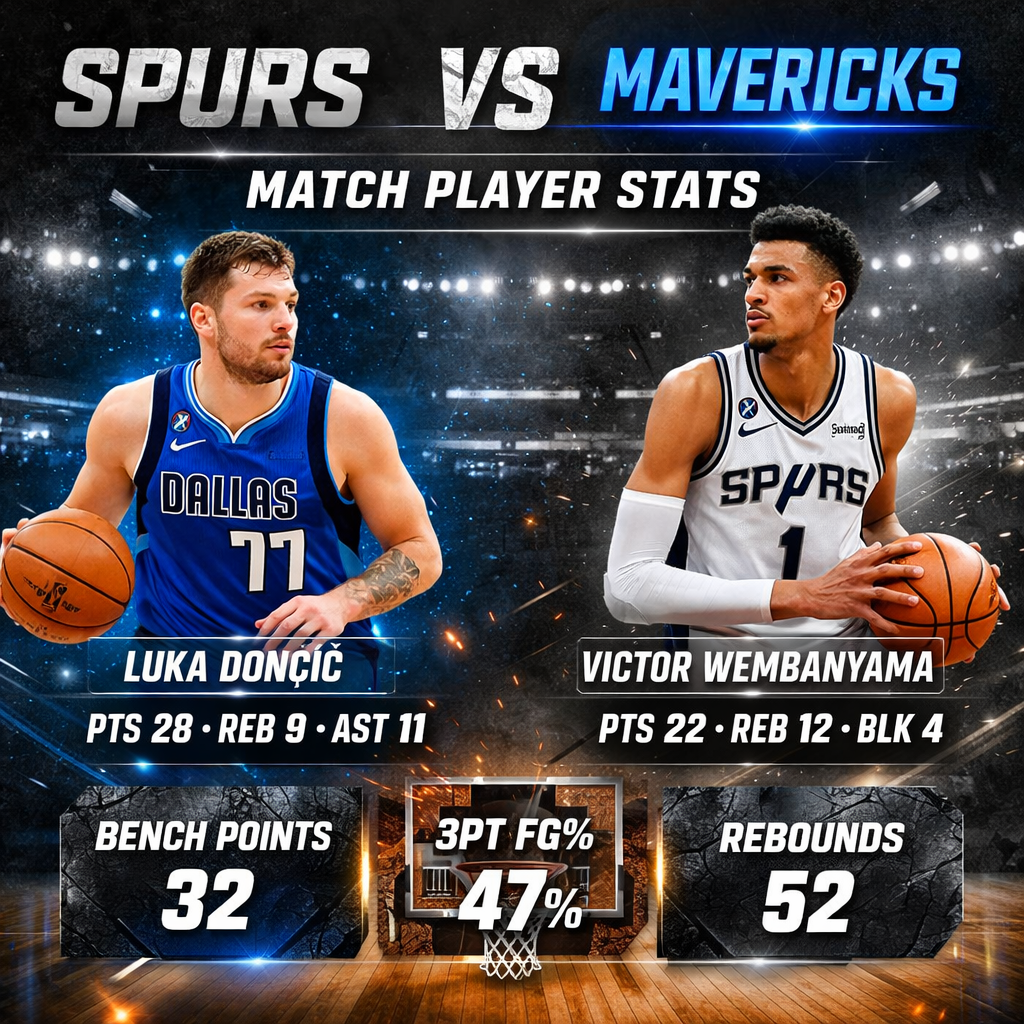
The opening quarter set the tone with high-paced offense and aggressive defensive schemes from both sides. The San Antonio Spurs vs Dallas Mavericks Match Player Stats leaned heavily on the playmaking brilliance of Luka Dončić, who orchestrated the offense with precision. His early stat line reflected efficiency, contributing double-digit points in the first quarter while also adding assists that created open perimeter looks for teammates. His usage rate was notably high, demonstrating Dallas’ strategy to establish rhythm through their franchise guard.
On the Spurs’ side, rookie sensation Victor Wembanyama immediately made his presence felt. His combination of length and agility translated into early rebounds and contested shots in the paint. Offensively, he showed versatility by scoring both inside and from mid-range. The first-quarter stats revealed balanced scoring from San Antonio Spurs vs Dallas Mavericks Match Player Stats with multiple players contributing rather than relying solely on one star.
Second Quarter Adjustments and Bench Impact
 As the game moved into the second quarter, bench production became a deciding factor. San Antonio Spurs vs Dallas Mavericks Match Player Stats saw a spark from Kyrie Irving, whose ability to break down defenders created scoring opportunities in isolation situations. His shooting percentage in this stretch was impressive, particularly from beyond the arc. The Mavericks’ bench collectively contributed crucial minutes, maintaining offensive efficiency while starters rested.
The Spurs countered with disciplined ball movement and transition play. Devin Vassell added perimeter scoring, knocking down timely three-pointers that kept San Antonio within striking distance. Meanwhile, Keldon Johnson attacked the rim aggressively, drawing fouls and converting free throws. Second-quarter player stats showed San Antonio narrowing the rebound margin and improving assist totals, reflecting stronger team chemistry.
Third Quarter Offensive Surge
The third quarter often determines the trajectory of closely contested games, and this matchup was no exception. San Antonio Spurs vs Dallas Mavericks Match Player Stats came out with a refined defensive focus, limiting second-chance points and forcing turnovers. Dončić’s stat sheet continued to expand as he recorded assists in double figures, showcasing his vision and passing accuracy. His ability to read defensive switches resulted in high-percentage shots for teammates.
For the Spurs, Wembanyama elevated his performance, recording multiple blocks that energized the team. His defensive rating during this period was among the best on the floor. Offensively, he capitalized on pick-and-roll opportunities, finishing efficiently at the rim. The Spurs’ third-quarter stats reflected improved field goal percentage and better spacing, largely due to strategic ball rotation.
Fourth Quarter Clutch Performances
In the final quarter, individual brilliance often outweighs system play. Irving stepped up with crucial late-game baskets, demonstrating composure under pressure. His clutch shooting percentage in the closing minutes was a defining statistical factor. Dallas also benefited from strong rebounding numbers, limiting the Spurs to one-shot possessions.
San Antonio responded with resilience. Johnson and Vassell combined for key buckets, while Wembanyama’s late defensive stops kept the game competitive. However, turnover differential proved costly for the Spurs. The Mavericks capitalized on fast-break opportunities generated from steals, which reflected directly in the points-off-turnovers category.
Shooting Efficiency and Scoring Breakdown
A deeper analysis of shooting efficiency provides insight into the final result. San Antonio Spurs vs Dallas Mavericks Match Player Stats maintained a higher overall field goal percentage, particularly from three-point range. Their effective field goal percentage highlighted the impact of perimeter scoring. Dončić and Irving together accounted for a significant portion of total team points, reflecting a star-driven offensive approach.
San Antonio Spurs vs Dallas Mavericks Match Player Stats scoring was more distributed. Multiple players reached double figures, demonstrating balanced offensive contribution. However, their three-point shooting percentage lagged slightly behind Dallas, which proved to be a statistical disadvantage. Free-throw accuracy remained solid for both teams, though Dallas attempted fewer shots from the line due to their reliance on jump shooting.
Rebounding Battle and Interior Defense
Rebounding statistics often reveal hidden narratives within a game. San Antonio Spurs vs Dallas Mavericks Match Player Stats secured a slight edge in total rebounds, particularly on the defensive glass. This limited San Antonio’s second-chance opportunities and allowed Dallas to control tempo. Dončić’s contribution in rebounding, unusual for a guard, significantly boosted team totals.
The Spurs showcased strong interior defense, largely influenced by Wembanyama’s rim protection. His block count altered several shot attempts beyond the recorded numbers. San Antonio’s defensive rebounds initiated fast breaks, yet inconsistent transition finishing reduced their scoring efficiency.
Assist-to-Turnover Ratio and Ball Movement
Ball security played a decisive role. San Antonio Spurs vs Dallas Mavericks Match Player Stats posted a superior assist-to-turnover ratio, reflecting disciplined offensive execution. Dončić’s assist numbers were complemented by minimal turnovers during crucial stretches. Irving also demonstrated effective decision-making, balancing scoring with playmaking duties.
San Antonio’s assist numbers were competitive, indicating cohesive ball movement. However, unforced turnovers in the fourth quarter shifted momentum. These mistakes translated directly into transition points for Dallas, highlighting the importance of composure in high-pressure moments.
Defensive Metrics and Player Impact
Defensive metrics such as steals, blocks, and defensive rating provided further clarity. Dallas recorded multiple steals that disrupted the Spurs’ offensive rhythm. Irving’s anticipation and perimeter defense contributed significantly to these numbers.
For San Antonio, Wembanyama’s shot-blocking and defensive presence stood out. His defensive win shares from the game reflected his overall impact beyond scoring. Johnson and Vassell also contributed with active perimeter defense, contesting shots and forcing difficult attempts.
Bench Production Comparison
Bench scoring can often swing close games. San Antonio Spurs vs Dallas Mavericks Match Player Stats second unit provided consistent scoring bursts, maintaining offensive flow when starters rested. Their bench efficiency rating exceeded that of San Antonio, particularly in the second quarter.
The Spurs’ bench demonstrated hustle and defensive effort but struggled with shooting consistency. While they contributed rebounds and assists, their field goal percentage was comparatively lower. This disparity in bench productivity influenced the overall point differential.
Advanced Analytics and Game Flow
Advanced statistics such as player efficiency rating, true shooting percentage, and plus-minus ratings offer deeper insight. San Antonio Spurs vs Dallas Mavericks Match Player Stats posted one of the highest efficiency ratings in the game, underscoring his all-around dominance. Irving’s true shooting percentage reflected remarkable shot selection and execution.
Wembanyama’s plus-minus rating highlighted his positive influence during his minutes on the court. Even when not scoring, his defensive impact and floor spacing benefited the Spurs. The advanced metrics collectively suggest that while San Antonio displayed promise and balance, Dallas executed more efficiently in key statistical areas.
Overall Player Performance Summary
The San Antonio Spurs vs Dallas Mavericks Match Player Stats reveal a contrast in offensive philosophy. Dallas relied heavily on star power, with Dončić and Irving combining for a substantial share of points, assists, and rebounds. Their efficiency and composure in critical moments ultimately defined the outcome.
San Antonio Spurs vs Dallas Mavericks Match Player Stats demonstrated growth, teamwork, and defensive potential. Wembanyama’s performance reinforced his status as a transformative player, while contributions from Johnson and Vassell reflected developing chemistry. Despite the loss, the Spurs’ statistical improvements in ball movement and interior defense signal positive momentum for future matchups.
Conclusion
The San Antonio Spurs vs Dallas Mavericks Match Player Stats paint a clear picture of competitive intensity and individual excellence. Dallas’ edge in shooting efficiency, turnover control, and clutch execution proved decisive. Meanwhile, San Antonio showcased resilience, defensive promise, and balanced scoring that could translate into future success. As both teams continue their campaigns, analyzing these statistical details provides valuable insight into strengths, weaknesses, and strategic adjustments. The rivalry remains compelling, fueled by star performances, emerging talent, and the pursuit of Western Conference supremacy.
You Many Also Read: Chicago Bulls vs Miami Heat Match Player Stats