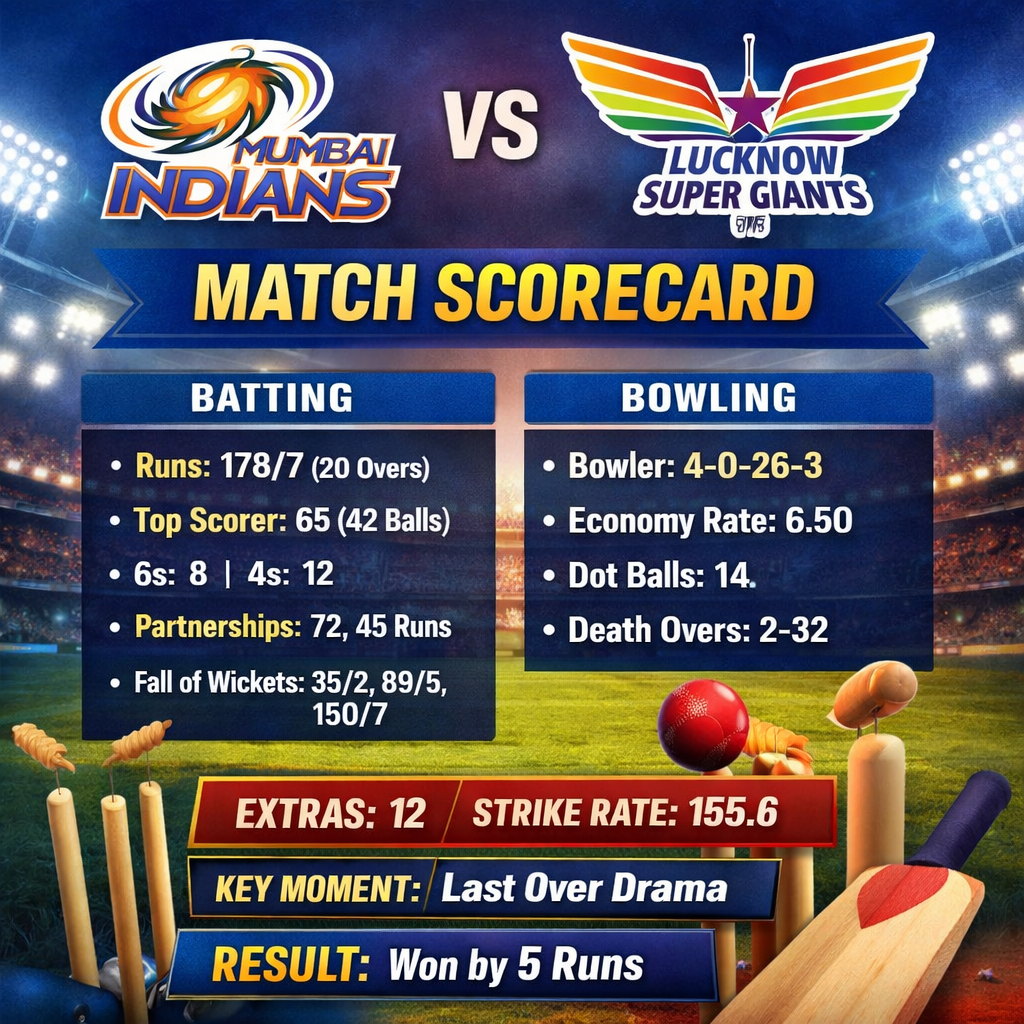
Introduction to Mumbai Indians vs Lucknow Super Giants Match Scorecard
The Mumbai Indians vs Lucknow Super Giants Match Scorecard offers a complete statistical picture of one of the most competitive clashes in the Indian Premier League. Every encounter between these two franchises brings intensity, tactical brilliance, and high-impact performances that are reflected clearly in the scorecard details. From the opening ball to the final over, the scorecard captures batting contributions, bowling efficiency, partnerships, strike rates, economy rates, extras, fall of wickets, and match result summary. A detailed scorecard is more than just numbers; it narrates the story of pressure moments, turning points, and individual brilliance that shaped the outcome.
First Innings Batting Performance Analysis
In the first innings, the batting side’s strategy is clearly visible through the Mumbai Indians vs Lucknow Super Giants Match Scorecard breakdown. The opening partnership often sets the tone, and the run rate during the powerplay plays a critical role in defining momentum. The top-order batters typically focus on aggressive stroke play while preserving wickets, aiming for a strong foundation. The scorecard highlights individual runs scored, balls faced, number of boundaries, sixes, and strike rate, giving a clear idea of who dominated the bowling attack.
A key aspect reflected in the Mumbai Indians vs Lucknow Super Giants Match Scorecard is the contribution from middle-order batters. In high-pressure matches, the middle overs often determine whether a team reaches a competitive total or falls short. Quick singles, calculated boundary hitting, and rotating strike against spinners are essential factors. If a batter registers a half-century or century, the scorecard emphasizes their dominance and ability to anchor the innings.
Lower-order contributions can also prove decisive. Even a quick 20 off 10 balls can shift the momentum dramatically. The scorecard records these impactful cameos, often highlighting the difference between a defendable and a below-par total.
Bowling Figures and Tactical Execution
The bowling section of the Mumbai Indians vs Lucknow Super Giants Match Scorecard reveals tactical execution in detail. Each bowler’s overs, maidens, runs conceded, wickets taken, and economy rate provide insights into how effectively they controlled the game. Powerplay specialists aim to take early wickets, while middle-over bowlers focus on restricting runs and building pressure.
Death-over bowling statistics are particularly crucial. The final overs often decide whether the batting side crosses the 180 or 200-run mark. A bowler conceding minimal runs in the 18th, 19th, or 20th over significantly impacts the match outcome. The scorecard reflects whether bowlers executed yorkers, slower deliveries, and variations successfully under pressure.
Wicket-taking spells stand out prominently. A three-wicket or four-wicket haul changes the course of a match, and such performances are clearly summarized in the bowling figures. Economy rates below seven runs per over in T20 cricket indicate strong control, while higher figures may signal expensive spells that benefited the batting side.
Key Partnerships and Momentum Shifts
 Partnership details are often included in expanded Mumbai Indians vs Lucknow Super Giants Match Scorecard offering insight into how the innings was built. A 70 or 100-run partnership stabilizes an innings and builds confidence. The fall-of-wickets column shows at what score and over each batter was dismissed, helping analysts identify turning points.
If early wickets fall, the pressure intensifies on the middle order. Conversely, a strong start can demoralize the bowling side. The scorecard timeline demonstrates momentum shifts clearly, especially when quick wickets fall in succession. These collapses often appear in clusters within a few overs, significantly affecting the final total.
Extras and Fielding Impact
Extras such as wides, no-balls, byes, and leg-byes may seem minor but can accumulate and influence results. The scorecard includes a separate extras column, revealing discipline levels of the bowling side. Frequent wides and no-balls not only add runs but also provide free-hit opportunities, which can lead to boundaries.
Fielding contributions, though not always deeply detailed in basic scorecards, are reflected through run-outs and caught dismissals. A direct-hit run-out or a stunning boundary catch can turn the tide of the match. The dismissal descriptions—caught, bowled, lbw, stumped, run-out—offer clues about fielding sharpness and bowling strategies.
Second Innings Chase Breakdown
When analyzing the second innings in the Mumbai Indians vs Lucknow Super Giants Match Scorecard the required run rate becomes the central focus. The chase scenario adds pressure, and the scorecard reflects whether the batting side maintained control or struggled to keep up.
The powerplay performance in a chase is crucial. A steady start without losing wickets helps maintain composure. The scorecard shows if the required run rate climbed due to dot-ball pressure or tight bowling spells. Middle-over consolidation often decides whether the chasing team stays in contention.
In close finishes, the final two overs become dramatic. The Mumbai Indians vs Lucknow Super Giants Match Scorecard captures the exact runs needed and balls remaining, illustrating whether the chase was comfortable or nerve-wracking. A last-over finish, especially with wickets in hand, adds excitement and is evident from the narrow margin in the result summary.
Individual Match-Winning Performances
Every memorable clash features standout performances. The scorecard highlights the Player of the Mumbai Indians vs Lucknow Super Giants Match Scorecard typically someone who made a decisive contribution with bat or ball. A century under pressure, a rapid fifty, or a four-wicket haul often earns this recognition.
All-round performances are especially valuable. A player scoring 40 quick runs and taking two key wickets significantly influences the result. Such dual contributions are clearly documented in both batting and bowling columns, reflecting overall impact.
Strike rates above 150 for batters and economy rates below seven for bowlers generally indicate high-quality performances. The scorecard allows fans and analysts to compare individual contributions objectively.
Comparative Team Statistics
Beyond individual brilliance, the Mumbai Indians vs Lucknow Super Giants Match Scorecard allows a comparison of team statistics. Total boundaries scored, six-hitting ability, dot-ball percentage, and wicket distribution reveal broader patterns. A team hitting more sixes often dominates momentum, while one maintaining a lower dot-ball ratio keeps the scoreboard ticking.
Bowling comparisons also stand out. If one team restricts the opposition effectively in middle overs, it shows in cumulative economy figures. Conversely, conceding too many runs in death overs can be costly. The overall totals—runs scored, wickets lost, overs faced—summarize team efficiency.
Tactical Decisions Reflected in the Scorecard
The toss decision and Mumbai Indians vs Lucknow Super Giants Match Scorecard conditions often influence strategy. Choosing to bat first might aim at setting a strong target, while chasing could exploit dew conditions. The scorecard outcome validates whether the toss decision proved advantageous.
Bowling changes, batting order adjustments, and use of impact players are reflected indirectly through performance numbers. Promoting a power-hitter up the order or introducing a spinner during the powerplay becomes evident in the over-by-over breakdown.
Pressure Moments and Turning Points
Crucial overs, such as double-wicket breakthroughs or 20-run overs, stand out when reviewing the Mumbai Indians vs Lucknow Super Giants Match Scorecard carefully. A sudden collapse from 120/2 to 130/5 can shift momentum dramatically. Likewise, a 25-run over in a chase can revive hopes instantly.
The fall-of-wickets chart, when read sequentially, narrates these turning points. Partnerships broken at critical junctures often define the final margin. Close finishes—decided by fewer than 10 runs or in the final over—are reflected in tight totals and remaining balls count.
Statistical Trends Across Encounters
When examining multiple Mumbai Indians vs Lucknow Super Giants scorecards, patterns may emerge. Some matches are high-scoring thrillers exceeding 190 runs, while others are low-scoring contests dominated by bowlers. The average first-innings score, highest individual score, and best bowling figures provide deeper insights.
Consistent performers often appear repeatedly in Mumbai Indians vs Lucknow Super Giants Match Scorecard building rivalries and reputations. A batter who frequently scores against a particular bowling lineup gains psychological advantage, and these repeated successes are evident statistically.
Match Result and Final Summary
The result section of the Mumbai Indians vs Lucknow Super Giants Match Scorecard concisely states whether the match was won by runs or wickets and the margin of victory. A win by 5 wickets indicates a successful chase with some control, while a victory by 20 runs suggests effective defense of a total.
Net run rate implications may also be inferred from the margin. A dominant win boosts standings, while a narrow loss can still provide confidence if the performance was competitive. The final summary encapsulates the essence of the contest in a few lines but is supported by the detailed numerical breakdown above.
Complete Scorecard Significance for Fans and Analysts
The Mumbai Indians vs Lucknow Super Giants Match Scorecard serves as a comprehensive reference for fans, fantasy league players, analysts, and cricket enthusiasts. It allows deep performance evaluation beyond surface-level commentary. Every run, wicket, and over contributes to a larger narrative of strategy, skill, and resilience.
By studying the scorecard carefully, one can identify strengths, weaknesses, and areas for improvement for Mumbai Indians vs Lucknow Super Giants Match Scorecard both teams. Batting depth, bowling consistency, fielding sharpness, and adaptability under pressure all become visible through structured statistics.
Ultimately, the Mumbai Indians vs Lucknow Super Giants Match Scorecard transforms a thrilling contest into measurable data, preserving every moment in numerical form. Whether it is a high-scoring thriller or a tightly fought low-total defense, the detailed scorecard ensures that the story of the game remains accessible, analyzable, and memorable long after the final ball is bowled.
Conclusion
The Mumbai Indians vs Lucknow Super Giants Match Scorecard provides a complete statistical narrative of the contest, capturing every crucial moment from the first delivery to the final result. It reflects batting dominance, bowling discipline, key partnerships, turning points, and pressure-filled overs that ultimately shape the outcome. Through detailed numbers such as strike rates, economy rates, fall of wickets, and margin of victory, the scorecard transforms a thrilling encounter into structured performance data. Beyond just runs and wickets, the scorecard highlights tactical decisions, individual brilliance, and team balance. It allows fans, analysts, and fantasy cricket players to evaluate performances objectively and understand how momentum shifted throughout the game.
You Many Also Read: Mumbai Indians vs Chennai Super Kings Match Scorecard