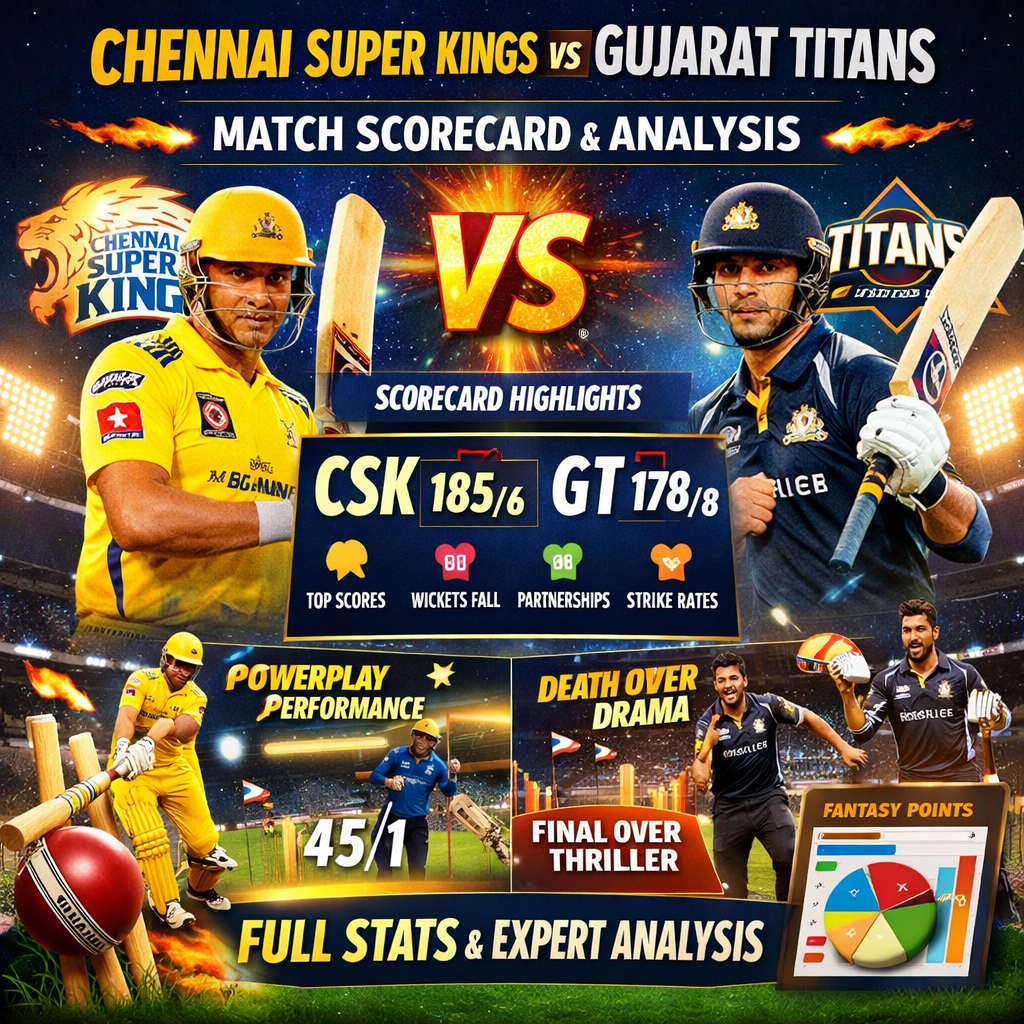
Introduction Chennai Super Kings vs Gujarat Titans Match Scorecard
The clash between Chennai Super Kings vs Gujarat Titans Match Scorecard has quickly become one of the most anticipated fixtures in the Indian T20 calendar. Every time these two sides meet in the Indian Premier League, fans expect high-intensity cricket, tactical brilliance, and dramatic momentum swings. The match scorecard from their encounters tells a story beyond numbers — it reflects power-hitting, disciplined bowling spells, strategic captaincy decisions, and match-defining partnerships. Whether the contest unfolds at Chepauk or in Ahmedabad, the scorecard typically highlights a balance between explosive top-order batting and clever death-over execution.
In this particular encounter, the Chennai Super Kings vs Gujarat Titans Match Scorecard captured a competitive first innings total built on calculated aggression. The batting side posted a challenging target by combining early caution with a strong middle-overs acceleration. The scoreboard progression showed steady run accumulation in the powerplay, followed by impactful boundary bursts that lifted the scoring rate above nine runs per over. Each segment of the innings revealed how carefully constructed partnerships form the backbone of a winning T20 total.
First Innings Batting Performance and Key Partnerships
The opening pair began with a composed approach, focusing on strike rotation and minimizing risk against the new ball. The powerplay Chennai Super Kings vs Gujarat Titans Match Scorecard reflected discipline rather than reckless hitting, ensuring wickets were preserved for later overs. As the field spread, the batters capitalized on gaps, converting singles into twos and punishing loose deliveries.
A pivotal partnership in the middle overs shifted the tempo dramatically. Chennai Super Kings vs Gujarat Titans Match Scorecard The set batter anchored the innings while his partner played the aggressor’s role, targeting the shorter boundary and exploiting matchups against particular bowlers. The scorecard showed a rapid 50-run stand coming in under five overs, pushing the run rate into double digits. Boundary distribution — including well-timed cover drives and lofted straight hits — highlighted technical excellence under pressure.
The finishing overs were equally critical. A late cameo of quick runs added vital momentum, ensuring the final total crossed the psychological benchmark often considered defendable in high-stakes games. The last three overs alone yielded a flurry of boundaries, demonstrating the importance of depth in batting.
Gujarat Titans Bowling Analysis and Wicket Breakdown
From the bowling perspective, Chennai Super Kings vs Gujarat Titans Match Scorecard relied on structured plans and variations in pace. The opening bowlers aimed to swing the ball early and contain scoring opportunities. Although the powerplay yielded moderate runs, they managed to claim an important breakthrough that briefly slowed momentum.
The middle overs featured tight lines and clever field placements. A crucial spell by the lead spinner created pressure, reflected in the dot-ball percentage recorded on the scorecard. The dismissal of a well-set batter turned the tide momentarily, and for a few overs, the required run rate dipped under control.
In the death overs, yorkers and slower deliveries were used strategically. Despite conceding boundaries, the bowlers managed to prevent a complete late-innings explosion. The wicket column revealed timely strikes that prevented an even larger total, showcasing composure in pressure situations.
Chennai Super Kings Bowling Strategy in the Chase
 When defending the total, Chennai Super Kings vs Gujarat Titans Match Scorecard approached the innings with clarity and structure. The opening bowlers targeted a tight off-stump line, forcing the chasing side to manufacture shots. Early wickets in the powerplay were reflected clearly on the scorecard, as the chasing team struggled to match the asking rate.
The spin department played a significant role in controlling the middle overs. With the field spread strategically, dot balls accumulated, increasing scoreboard pressure. The run rate equation began to climb steadily, compelling batters to attempt high-risk strokes.
In the death overs, experienced campaigners executed slower balls and wide yorkers effectively. The scoreboard narrative shifted as required runs mounted sharply, turning the contest into a test of temperament.
Individual Batting Highlights and Milestones
Among standout performers, a commanding innings from Shubman Gill (if representing the Titans in the chase) demonstrated classical stroke play blended with modern aggression. His half-century came with a high strike rate, featuring elegant drives and well-placed pulls. The scorecard underlined his consistency, as he anchored the innings while rotating strike efficiently.
On the Chennai Super Kings vs Gujarat Titans Match Scorecard side, an impactful contribution from Ravindra Jadeja added crucial runs in the middle overs. His ability to accelerate without losing balance ensured the innings maintained upward momentum. His strike rotation also frustrated bowlers who sought dot-ball pressure.
The finishing presence of MS Dhoni, even if brief, electrified the atmosphere. A short cameo featuring powerful hits in the final overs elevated the total and energized the crowd. His calculated shot selection once again highlighted why he remains a finisher admired across cricketing circles.
All-Round Contributions and Turning Points
All-round impact often defines matches between these two sides. Hardik Pandya, known for his dual capabilities, influenced the match with both bat and ball. His bowling spell contained crucial variations, while his batting intent kept the chase alive until the closing stages.
Another decisive factor came from the spin department, where Rashid Khan showcased tight control. His economy rate reflected discipline, and his wicket-taking ability disrupted partnerships at vital moments. The scorecard recorded how his overs shifted momentum by reducing scoring opportunities and forcing aggressive risks.
A dramatic catch near the boundary line and a direct-hit run-out further altered the course of the Chennai Super Kings vs Gujarat Titans Match Scorecard. Fielding efficiency, often overlooked in summaries, was prominently visible in the wicket-fall sequence.
Powerplay and Middle-Overs Comparison
A closer look at the powerplay statistics shows contrasting approaches. The team batting first prioritized wicket preservation, ending the first six overs with a stable yet competitive tally. In comparison, the chasing side attempted aggressive strokes early but lost wickets, resulting in scoreboard pressure.
The middle overs revealed a battle between spin control and boundary searching. Dot-ball percentages increased, and partnerships became harder to establish. This phase often determines T20 outcomes, and the scorecard clearly indicated how disciplined bowling spells slowed scoring momentum.
Death Overs Drama and Final Equation
As the Chennai Super Kings vs Gujarat Titans Match Scorecard approached its climax, the required run rate escalated sharply. The scoreboard pressure became visible in risky shot selection and missed connections. The penultimate over proved decisive, either through a crucial wicket or a boundary that swung hope in favor of one side.
In the final over, the equation narrowed to a manageable yet tense target. A combination of yorkers, slower balls, and strategic field placements forced the batter to take calculated risks. The final scoreline ultimately reflected composure under pressure.
Captaincy Decisions and Tactical Depth
Strategic field placements, bowling changes, and batting order adjustments defined the Chennai Super Kings vs Gujarat Titans Match Scorecard narrative. Chennai Super Kings vs Gujarat Titans Match Scorecard leadership relied on experience, rotating bowlers based on matchups and pitch behavior. Gujarat’s tactical decisions aimed to maximize power-hitting phases and exploit favorable overs.
The toss decision also influenced strategy. Whether opting to bat first or chase, the captain’s reading of pitch conditions and dew factor shaped the overall approach. Subtle changes — such as introducing spin early or delaying a key pacer — were evident in the match flow.
Statistical Summary and Match Impact
The final Chennai Super Kings vs Gujarat Titans Match Scorecard encapsulated runs scored, balls faced, strike rates, economy rates, and wicket distributions. Boundary counts, dot-ball ratios, and partnership totals provided deeper insight into the contest. The winning margin — whether by runs or wickets — highlighted how fine the margins are between these competitive sides.
Net run rate implications and points table movements further added context. Chennai Super Kings vs Gujarat Titans Match Scorecard A victory in such a high-profile encounter often boosts team morale and influences playoff scenarios. For fans and analysts, the numbers serve as both record and narrative, illustrating how every over contributes to the bigger picture.
Conclusion
Matches between Chennai Super Kings vs Gujarat Titans Match Scorecard consistently deliver drama, skill, and tactical depth. The scorecard from this encounter stands as evidence of modern T20 evolution — where adaptability, composure, and all-round strength decide outcomes. Each innings progression, wicket fall, and partnership milestone forms part of a broader rivalry that continues to captivate audiences. As seasons progress, future clashes will undoubtedly add new chapters to this competitive storyline. For now, this match scorecard remains a detailed snapshot of elite cricketing excellence, reflecting why encounters between these two franchises rank among the most thrilling in the tournament’s history.
You Many Also Read: Chennai Super Kings vs Sunrisers Hyderabad Standings