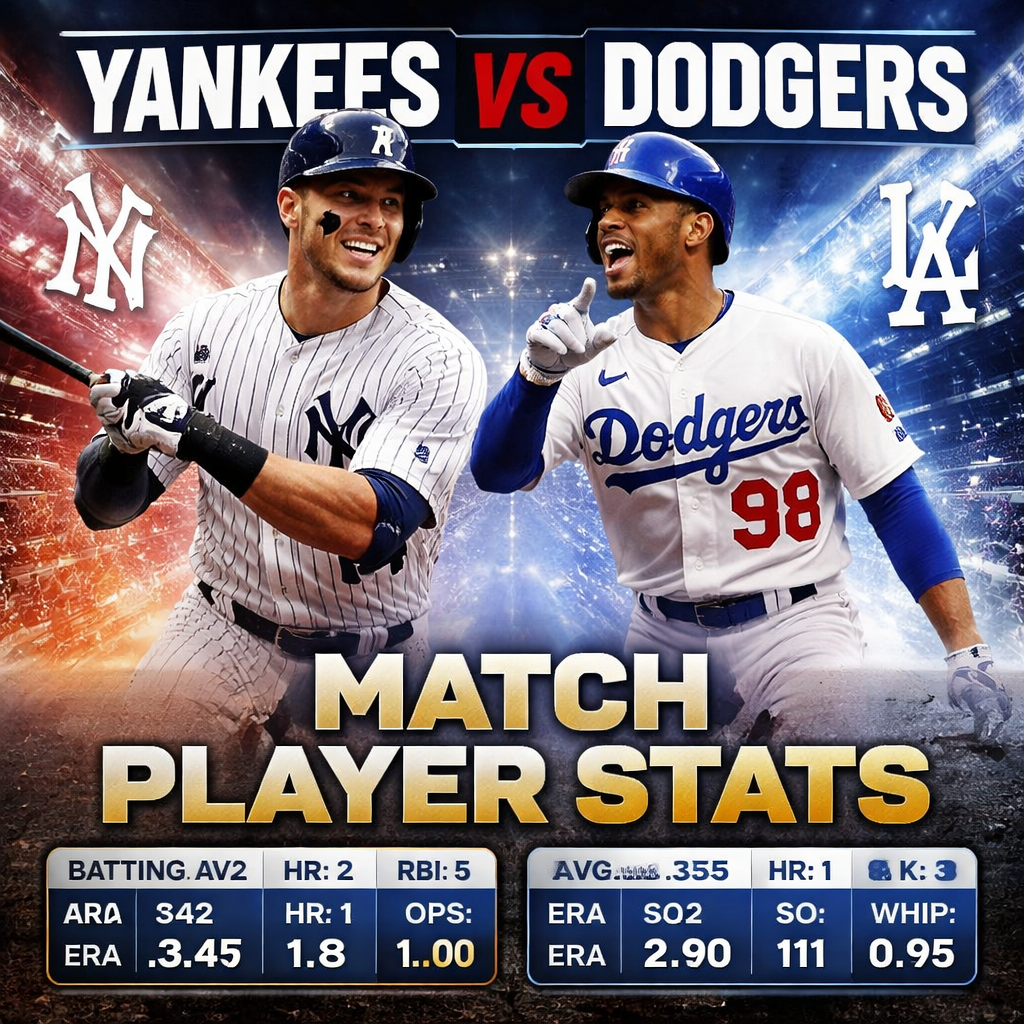
Introduction New York Yankees vs Dodgers Match Player Stats
When two of New York Yankees vs Dodgers Match Player Stats most historic franchises meet, the spotlight naturally shifts to player performance and statistical impact. A matchup between the Yankees and the Dodgers is more than a regular-season contest; it is a data-rich battle where every at-bat, pitch count, and defensive play contributes to a broader narrative. From batting averages and on-base percentages to ERA and strikeout rates, match player stats reveal how individual performances shape the outcome of this iconic interleague clash.
Both teams traditionally enter such games with deep lineups, strong rotations, and elite bullpens. Therefore, statistical comparison becomes essential in understanding which players influenced momentum, controlled scoring opportunities, and ultimately dictated the result. Whether the game is held in New York Yankees vs Dodgers Match Player Stats player metrics provide the clearest picture of competitive edge.
Offensive Performance Breakdown
Offensive production is typically the first area analysts examine. Key metrics include batting average (AVG), on-base percentage (OBP), slugging percentage (SLG), and runs batted in (RBIs). In New York Yankees vs Dodgers Match Player Stats matchups, star hitters often deliver high-impact moments that are reflected directly in these numbers.
For the New York Yankees vs Dodgers Match Player Stats power hitting is frequently central to their strategy. A multi-hit game combined with extra-base hits dramatically raises team slugging percentage. When a Yankees slugger posts a 2-for-4 or 3-for-5 line with a home run and multiple RBIs, the offensive pressure shifts heavily in their favor. Walk rates also matter significantly; disciplined plate appearances that result in walks boost OBP and extend innings.
The New York Yankees vs Dodgers Match Player Stats on the other hand, are often praised for lineup depth. Production does not rely solely on one superstar but rather on consistent contributions across the batting order. When several Dodgers players record hits in a single game, their cumulative batting average for the matchup rises, creating scoring chains that challenge opposing pitchers.
Star Power and Key Hitters
 In high-profile matchups, superstars frequently define the stat sheet. For New York Yankees vs Dodgers Match Player Stats players like Aaron Judge can dominate with towering home runs and clutch RBIs. His slugging percentage in interleague play is often a focal point, especially when facing elite pitching. A single swing can alter win probability dramatically, and advanced metrics such as OPS (on-base plus slugging) illustrate his all-around offensive value.
For New York Yankees vs Dodgers Match Player Stats Mookie Betts provides a dynamic combination of contact hitting, speed, and defensive excellence. In Yankees vs Dodgers games, Betts’ ability to get on base, steal bases, and score runs frequently appears in the box score as multi-dimensional statistical output. His WAR (Wins Above Replacement) contribution often highlights his complete impact beyond simple batting average.
When both stars perform well in the same game, the statistical duel becomes even more compelling, with fans and analysts comparing home run totals, RBIs, and run creation metrics.
Starting Pitcher Analysis
Starting pitching sets the tone for the entire matchup. Earned run average (ERA), WHIP (walks plus hits per inning pitched), and strikeout-to-walk ratio are central indicators of effectiveness. In New York Yankees vs Dodgers Match Player Stats games, starting pitchers are often tasked with navigating lineups stacked with All-Star talent.
A New York Yankees vs Dodgers Match Player Stats starter delivering six or seven innings with limited earned runs dramatically reduces bullpen strain. High strikeout totals indicate command and dominance, while low walk numbers reflect efficiency. Conversely, allowing multiple home runs or struggling with pitch location can inflate ERA and shift momentum.
Dodgers starters are typically known for pitch variety and velocity control. A strong outing might include double-digit strikeouts and a low pitch count through five innings. Advanced metrics such as FIP (Fielding Independent Pitching) help evaluate performance beyond defensive support, revealing how effectively the pitcher controlled outcomes directly.
Bullpen Contributions
Relief pitching often determines the final result in close games. Bullpen ERA, inherited runners scored, and save percentage are crucial statistics. In tight Yankees vs Dodgers contests, late-inning arms face immense pressure.
For New York, a closer entering with a one-run lead must maintain composure and command. A successful save increases team confidence and improves individual save totals. Middle relievers who strand runners contribute significantly, even if their names do not headline the stat sheet.
Los Angeles typically relies on matchup-based bullpen strategies. Specialists are used against specific hitters, and their strikeout percentages against left- or right-handed batters become vital data points. When relievers execute clean innings with minimal pitches, the bullpen efficiency rating strengthens.
Defensive Metrics and Fielding Impact
Defense often goes unnoticed until a critical error or spectacular play changes the game. Fielding percentage, defensive runs saved (DRS), and range factor are significant statistical indicators.
The New York Yankees vs Dodgers Match Player Stats infield coordination can prevent extra-base hits by converting difficult ground balls into outs. A double play in a high-leverage situation reduces scoring probability and directly affects run expectancy charts.
The Dodgers are widely recognized for defensive versatility. Outfield assists, diving catches, and accurate throws to home plate can eliminate scoring chances. Defensive statistics in Yankees vs Dodgers games frequently highlight which team capitalized on limited opportunities.
Head-to-Head Historical Player Trends
Historical performance adds another layer to New York Yankees vs Dodgers Match Player Stats. Some hitters consistently perform well against certain pitchers, reflected in favorable batting averages in head-to-head matchups. For example, a batter hitting .350 against a specific starter carries psychological and statistical confidence into the game.
Similarly, pitchers may demonstrate dominance over particular sluggers, maintaining low opponent batting averages across multiple encounters. These trends influence managerial decisions, such as lineup adjustments or bullpen substitutions.
Over decades of competition within Major League Baseball, Yankees vs Dodgers games have produced iconic statistical performances, reinforcing the rivalry’s legendary status.
Advanced Analytics and Sabermetrics
Modern baseball analysis goes beyond traditional box scores. Metrics like exit velocity, launch angle, and hard-hit rate provide deeper insight into offensive productivity. In Yankees vs Dodgers matchups, a player may record an out but still display high exit velocity, suggesting strong underlying performance.
Pitch tracking data also reveals spin rate, pitch movement, and location accuracy. A New York Yankees vs Dodgers Match Player Stats pitcher with a high spin rate fastball can induce weak contact, reflected in ground-ball percentages. Meanwhile, Yankees hitters focusing on launch angle optimization may increase home run probability.
These advanced stats help explain not just what happened, but why it happened, offering predictive value for future matchups.
Situational Performance Statistics
Clutch performance often separates victory from defeat. Batting average with runners in scoring position (RISP) is one of the most telling metrics in high-pressure games. A team that capitalizes on these opportunities typically controls the scoreboard.
The New York Yankees vs Dodgers Match Player Stats situational hitting might include sacrifice flies or productive outs that move runners forward. Even without a hit, these plays affect run expectancy and overall efficiency.
The Dodgers often emphasize plate discipline in tight moments. Drawing walks with bases loaded or forcing pitchers into deep counts increases scoring opportunities and pitch fatigue.
Late-inning statistics, including ninth-inning ERA and extra-inning batting averages, further illustrate which team maintains composure under pressure.
Comparative Team Totals
Team totals summarize individual efforts into a broader statistical framework. Total hits, runs, errors, and left-on-base figures help interpret overall performance balance.
If the New York Yankees vs Dodgers Match Player Stats accumulate 10 hits but score only three runs, inefficiency with runners on base becomes evident. Conversely, a Dodgers lineup converting fewer hits into more runs demonstrates timely hitting and strategic execution.
Pitch counts and total strikeouts also provide insight into game tempo and dominance. A combined 20-plus strikeouts between both teams suggests a pitching-heavy duel, while high hit totals reflect offensive firepower.
Impact of Ballpark Factors
Ballpark dimensions can subtly influence player statistics. New York Yankees vs Dodgers Match Player Stats Stadium’s short right-field porch favors left-handed power hitters, potentially inflating home run numbers. Meanwhile, Dodger Stadium’s spacious outfield may lead to more doubles and triples rather than home runs.
Understanding park-adjusted metrics such as OPS+ allows analysts to contextualize performance fairly. A home run in one stadium may statistically carry different weight compared to another environment.
Momentum Shifts Reflected in Stats
Momentum in baseball is often mirrored in inning-by-inning scoring summaries. A three-run fifth inning can transform win probability charts dramatically. Player stats from that inning—hits, RBIs, walks—become pivotal markers of change.
Pitching fatigue may appear statistically as declining velocity or increased walk rates in later innings. Offensive surges often correlate with improved contact percentages as hitters adjust to pitching patterns.
Tracking these in-game statistical shifts reveals how the narrative evolves beyond the final score.
Conclusion
New York Yankees vs Dodgers Match Player Stats provide a comprehensive story of strategy, execution, and individual brilliance. Offensive metrics showcase power and discipline, pitching data highlights control and dominance, and defensive numbers underline precision and teamwork. From superstar showdowns to bullpen resilience, every statistical category contributes to understanding the game’s outcome. Advanced analytics further enhance this analysis, offering insight into performance sustainability and predictive trends. Ultimately, the numbers reflect more than performance—they capture moments of pressure, bursts of momentum, and the competitive intensity between two legendary franchises. By studying batting lines, ERA figures, situational splits, and advanced metrics, fans and analysts gain a complete and compelling picture of this iconic baseball rivalry.
You Many Also Read: San Antonio Spurs vs Dallas Mavericks Match Player Stats